Our work

Evidence, leadership and implementation around complex public challenges.

AFLI combines rigorous analysis, trusted convening and grounded regional knowledge to help institutions and communities move from policy intent to practical results.

01

Governance, Parliament and citizen accountability

Monitoring public leadership, translating laws and budgets into usable information, and enabling citizens to assess services and engage duty-bearers constructively.

  • Parliamentary and policy monitoring
  • Budget and service-delivery oversight
  • Transparency, accountability and anti-corruption training
  • Multi-stakeholder civic engagement
02

Peace and regional security

Connecting security dialogue with community ownership, lawful mobility, shared resources, livelihoods and cross-border cooperation.

  • Uganda–Kenya bilateral engagement
  • Ateker dialogue and cultural diplomacy
  • Transitional justice and reconciliation
  • Protection of peace gains
03

Policy research and strategic advice

Turning field evidence, institutional memory and specialist analysis into concise choices for leaders and public institutions.

  • Policy briefs and executive memoranda
  • Research synthesis and programme diagnostics
  • Strategy and implementation frameworks
  • Decision, risk and action tracking
04

Inclusive economic transformation

Connecting land, livestock, productive livelihoods, investment, value chains and regional markets to shared prosperity.

  • Pastoral and livestock economies
  • Regional development and investment planning
  • Cooperative and value-chain development
  • Community participation and benefit sharing
05

Institutional strengthening and knowledge systems

Helping public and civic institutions organise evidence, preserve institutional memory and manage implementation coherently.

  • Information and records systems
  • Research repositories and databases
  • Institutional alignment and mandate review
  • Technical quality assurance
06

Community systems and service delivery

Building local information systems, community–facility linkages and practical platforms that improve service use and accountability.

  • Community monitoring groups
  • Land rights and local institutions
  • Youth skills and enterprise
  • Child survival, health advocacy and service-use information
Regional development and investment support

From regional evidence to decisions and investable opportunities.

AFLI supports public institutions, regional leaders and technical partners to turn dispersed evidence into coherent planning and investment products. Its contribution can span research design, synthesis, policy alignment, document architecture, executive briefing and investor communication.

01

Regional development plans

Long-horizon frameworks that connect regional priorities with national policy, delivery institutions, financing and measurable implementation pathways.

02

Comprehensive investment profiles

Evidence-led regional baselines covering productive sectors, infrastructure, human capital, investment climate, risks and prioritised project pipelines.

03

Executive decision briefs

Short, decision-oriented documents that identify what the evidence establishes, what remains uncertain and the actions requiring leadership direction.

04

Investor-facing documents

Prospectuses, investors’ packs and presentation materials that translate technical analysis into opportunities, readiness stages, risks and clear partnership asks.

Representative portfolio · Lango · 2025–2036

Planning, profiling and investment promotion

The Lango document suite includes the Lango Economic Development Plan 2025–2035, a 329-page Comprehensive Investment Profile 2026–2036, an executive summary for principals, an investment prospectus, an investors’ presentation pack and a regional integration and investment-enabling strategy. AFLI is identified among the technical and collaborative institutions supporting parts of this multi-institutional body of work.

  • Links regional priorities to Vision 2040, NDP IV and the national growth agenda.
  • Organises sector evidence and a staged project pipeline for policy and investment engagement.
  • Provides different formats for public leaders, implementing institutions, development partners and investors.

Representative portfolio · Karamoja · 2023–2036

Evidence discipline and decision support

The portfolio connects the 2023 Karamoja Regional Development Plan synthesis with the later investment-planning package. The synthesis reviewed previous interventions and proposed an integrated 2035 framework; the current profile, executive brief, data-gap register and field register extend that evidence base for stakeholder review and data completion.

  • Separates documented programme experience from projections, proposals and unresolved data gaps.
  • Connects peace and governance with livestock, crop production, mining, tourism, infrastructure and human development.
  • Converts a large technical record into focused decisions, data requests and next steps.
Open the 2023 synthesis report ↗

Cooperative strategy · Uganda · Draft 2025–2035

Teacher-led enterprise and value-chain development

The draft Walimu Cooperative Union Economic and Commercial Strategy proposes a ten-year pathway from salary dependence towards cooperative finance, productive enterprise, school-based economic activity, integrated markets and stronger governance.

  • Organises delivery around five mutually reinforcing strategic pillars.
  • Sequences institutional strengthening, enterprise rollout, market expansion and export growth.
  • Presents 2035 targets as projections requiring validation, financing and phased implementation.
Open draft strategy PDF ↗

Document access and status: public summaries describe the nature of this work. Draft, restricted and approval-dependent documents are not published as open downloads without the responsible institution’s clearance.

Discuss regional planning support →

Mentorship and international learning

Students learn by contributing to real public-interest work.

AFLI runs an active mentorship programme for local students and international students undertaking exchange or internship placements through foreign universities. Placements combine structured supervision, regular feedback and an applied assignment linked to AFLI’s research, advocacy and regional policy work.

International placements have included students from the International Work–Global Studies programme at the School of Education and Communication, Jönköping University, Sweden. The university’s placement model combines academic learning with supervised experience in sustainable development, migration and integration, and peace and conflict.

Enquire about mentorship
01

Orientation and learning plan

A designated mentor agrees the placement objectives, introduces the student to AFLI’s work and defines an appropriate assignment.

02

Supervised applied work

Students undertake research, analysis, communication or project-development tasks with routine guidance and professional feedback.

03

Review and learning

Progress is reviewed during the placement and the final output is assessed before it is treated as an AFLI product or used externally.

Examples of mentored student work · 2023

Applied outputs connected to AFLI programmes

  • An advocacy strategy on pastoral communities’ participation in mineral-resource governance in Kaabong and Moroto.
  • A community-awareness flyer on pastoral rights, communal land institutions and mineral governance.
  • A draft press release explaining Uganda–Kenya cross-border resource-sharing issues.
  • A programme advisory note prepared for development-partner consideration.

Editorial status: these materials demonstrate learning and supervised contribution. Student drafts, attendance records and advisory working papers are not automatically final AFLI publications or institutional positions.

Social accountability

Equipping civil society and communities to follow public resources.

AFLI developed the Joint CSO Training Manual and four handbooks on Transparency, Accountability and Anti-Corruption (TAAC). Produced with the Office of the Auditor General, the Inspectorate of Government and the Public Procurement and Disposal of Public Assets Authority, with support from GIZ, the series covers corruption, anti-corruption institutions, procurement law, service delivery and infrastructure monitoring.

The materials have helped build the capacity of civil-society organisations in the district. AFLI’s Citizens TAAC Service Delivery Monitoring Framework also organises communities into groups that track budgets and services, document findings and raise them directly with duty-bearers. An MoU with the Inspectorate of Government’s Moroto Branch supports this work.

Explore the TAAC evidence series →

Office of the Auditor General

Institutional co-publisher of the joint training handbooks, contributing the public-audit and accountability perspective.

Inspectorate of Government

Institutional co-publisher. AFLI also has an MoU with the Moroto Branch Office to support citizen TAAC service-delivery monitoring.

PPDA

Institutional co-publisher, contributing procurement law, contract monitoring and public-infrastructure oversight content.

GIZ

Supported the production of the Joint CSO Training Manual and its four TAAC handbooks.

Strategic policy advisory support

AFLI support to CC-OWC and SPAD

AFLI, in partnership with Operation Wealth Creation, provides research, policy analysis and strategic advice to support informed decision-making and effective implementation of Government of Uganda programmes. This work contributes to the Office of the President’s APEX coordination mechanism and addresses governance and development challenges.

AFLI’s Executive Director, supported by professional staff and Board members, serves as Principal Advisor to General (Rtd.) Caleb Akandwanaho (Salim Saleh), Chief Coordinator of OWC and Senior Presidential Advisor on Defence. AFLI provides evidence-based recommendations to identify implementation gaps, assess policy options and propose corrective action for consideration by the President and APEX leadership.

Aligned with ongoing government reforms and restructuring, the partnership supports better coordination, accountable leadership and responsive public administration. Its goal is to improve livelihoods and quality of life by encouraging shared responsibility between communities and their leaders, strengthening public trust, participation and sustained development.

This public description presents the purpose and institutional value of the partnership. It does not disclose confidential agreements, restricted operating arrangements or unpublished terms.

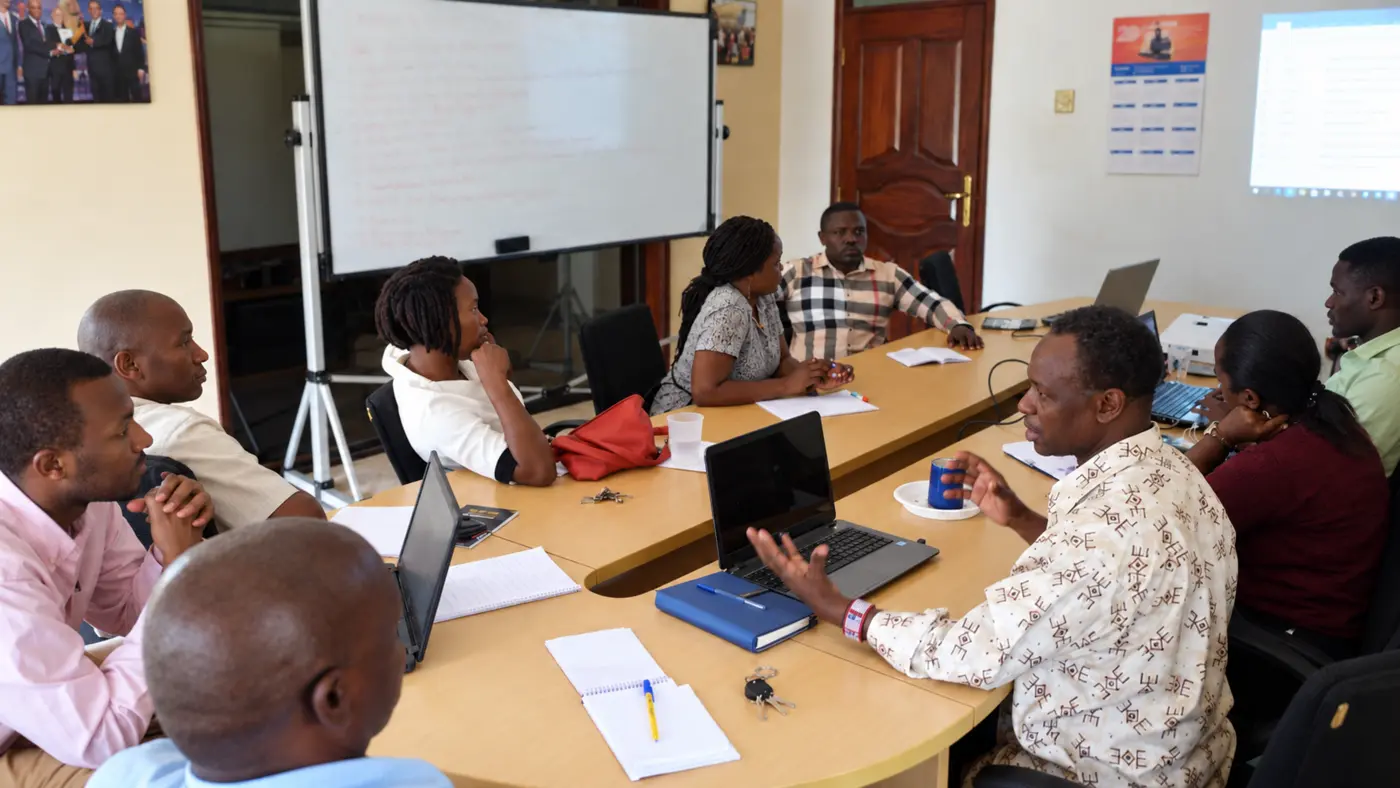
AFLI Executive Director Hon. David Bwangamoe Pulkol in discussion with senior AFLI staff during a planning session
AFLI’s Executive Director and senior staff during an institutional planning and discussion session.

Collaborative practice

Planning together. Testing evidence. Agreeing the way forward.

AFLI’s work is shaped through structured discussion among leadership, researchers and programme specialists. These sessions bring field evidence, institutional experience and different professional perspectives into practical plans, policy advice and implementation decisions.

How we work

From a defined question to measurable follow-through.

Listen→Research→Convene→Advise→Support delivery→Review

AFLI’s government-facing advisory experience includes policy synthesis, applied research, knowledge management, executive briefing and coordination support. Confidential instruments and restricted operating arrangements are not published.